Menus
Introducion
A menu is a (mptt) tree of pagetools.menus.models.MenuEntry objects.
A menu entry encapsulates a generic content_object.
The content_object must provide a get_absolute_url method.
To be visible to unauthorized users a menu entry needs to have set the attribute enabled to True.
The root node of a menu is a proxy model of menu entry, pagetools.menus.models.Menu.
The content object of a menu is a pagetools.menus.models.MenuCache object.
The Menu admin
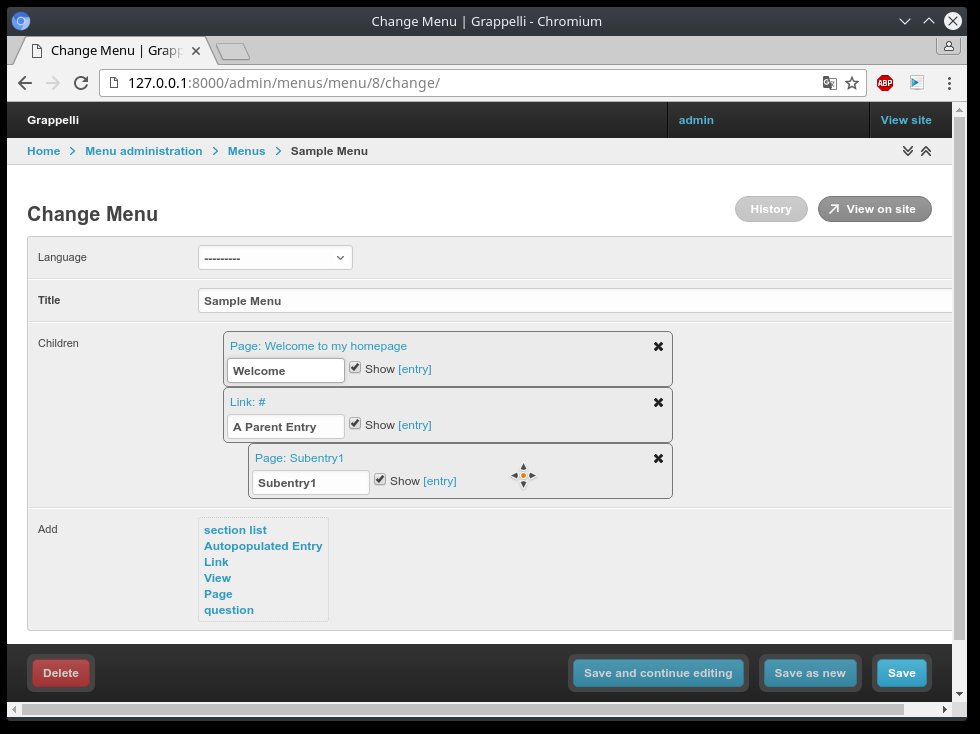
Once a menu is created it’s admin page can be used to add/remove and edit both the entries and their content objects and reorder the entries through drag and drop.
The menu tag
A menu is meant to be called in the template with the template tag menu. In contrast to a Menu Entry object, a menu is always enabled, the usage of the enabled property is overwritten and determinates if the menu cache is to be used.
For dynamic menu entries (e.g. only visible to authorized users) the menu cache can’t be used. But there is no limitation of the number of menus, so this possible:
{% load menus_tags %}
<ul class="menu ...">
{% menu CommonMenu menukeys %} {# enabled=True = use cache #}
{% menu UserMenu menukeys %} {# enabled=False = no cache #}
</ul>
The menu template
The template used to render the menu is set in settings.PT_MENU_TEMPLATE.
To support nested menus it must be able to call it self recursively,
see the templates django-pagetools/pagetools/menus/templates/menu.html.
There are also
- foundation_nav_menu.html
- foundation6_nav_menu.html
- bootstrap_nav_menu.
Menu entry content objects
There are some classes that are meant to be used as menu entry content objects.
They will be listed in the ‘Add entry` section of the menu admin.
Furthermore all models which admin class inherits from pagetools.menus.admin.EntriableAdmin or
were modified by pagetools.menus.admin.make_entrieable_admin() are shown there.
Link
pagetools.menus.models.Link
Just a simple link to anything.
ViewLink
pagetools.menus.models.ViewLink
A link to a view. The view must have a reverse name and cant’ have any parameters.
To be shown in the corresponding admin choice field, somewhere
pagetools.menus.utils.entrieable_reverse_name() must be called with the reverse name of the view. It returns the name,
so that could be done directly in a urls.py:
patterns = [
(r'/foo', MyView.as_view(), name=entriebale_reverse_name("Foo")),
]
With an app name in the urls:
app_name = "myapp"
patterns = [
(r'/foo', MyView.as_view(), name=entriebale_reverse_name("Foo", app_name="myapp")),
]
AutoPopulated
pagetools.menus.models.AutoPopulated. An entry with sub entries which are generated by a callback.
See App integration for an example.
Dashboard Menu Module
The pagetools.menus.dashboard_modules.MenuModule can be included in the dashboard. It has one additional parameter
title which is the name of the menu. The default is MainMenu.